🎉 Calla - Delivery & Pickup Date is available now on Shopify app store

Shopify app store


Imagine logging into your Shopify store one morning and finding that ChatGPT, Google AI Mode, and Microsoft Copilot are already recommending your products to buyers without you lifting a finger. Sounds like science fiction? It is happening right now. Yet most Shopify merchants still have no idea which AI trends are real, which ones are hype, and most critically, which ones are quietly sending revenue to their competitors.
If you have ever typed a search like "AI ecommerce trends Shopify merchants need to know," you are already asking the right question. The problem is that most answers are generic. They talk about AI in broad strokes and leave you with zero clarity on what to actually do with your store today.
This guide is different. Every trend here is mapped directly to a Shopify-native feature, a real use case, and a measurable revenue outcome. No fluff. No theory. Just a clear, actionable playbook built specifically for Shopify store owners who want to grow faster in 2026.
The AI ecommerce landscape is shifting faster than most merchants realize. Three macro forces are reshaping how customers find, evaluate, and buy products online. Understanding them is not optional. It is a competitive survival skill.
Keyword-based Google search dominated ecommerce for two decades. That era is ending. Buyers increasingly use conversational AI tools such as ChatGPT, Google AI Mode, Gemini, and Microsoft Copilot to ask questions, compare products, and even complete purchases without ever visiting a brand website.
According to Shopify's own documentation, products can now be discovered and purchased through AI channels that act as autonomous shopping agents. This is not a future prediction. Shopify's Changelog has already released an "Agentic Storefronts" feature that lets merchants track their AI-channel presence and rank in AI assistant queries.
What does this mean for your store? It means search engine optimization alone is no longer enough. Your product data, your catalog structure, and your metadata must now be optimized for AI systems that read, interpret, and recommend products based on semantic understanding, not just keyword matching.
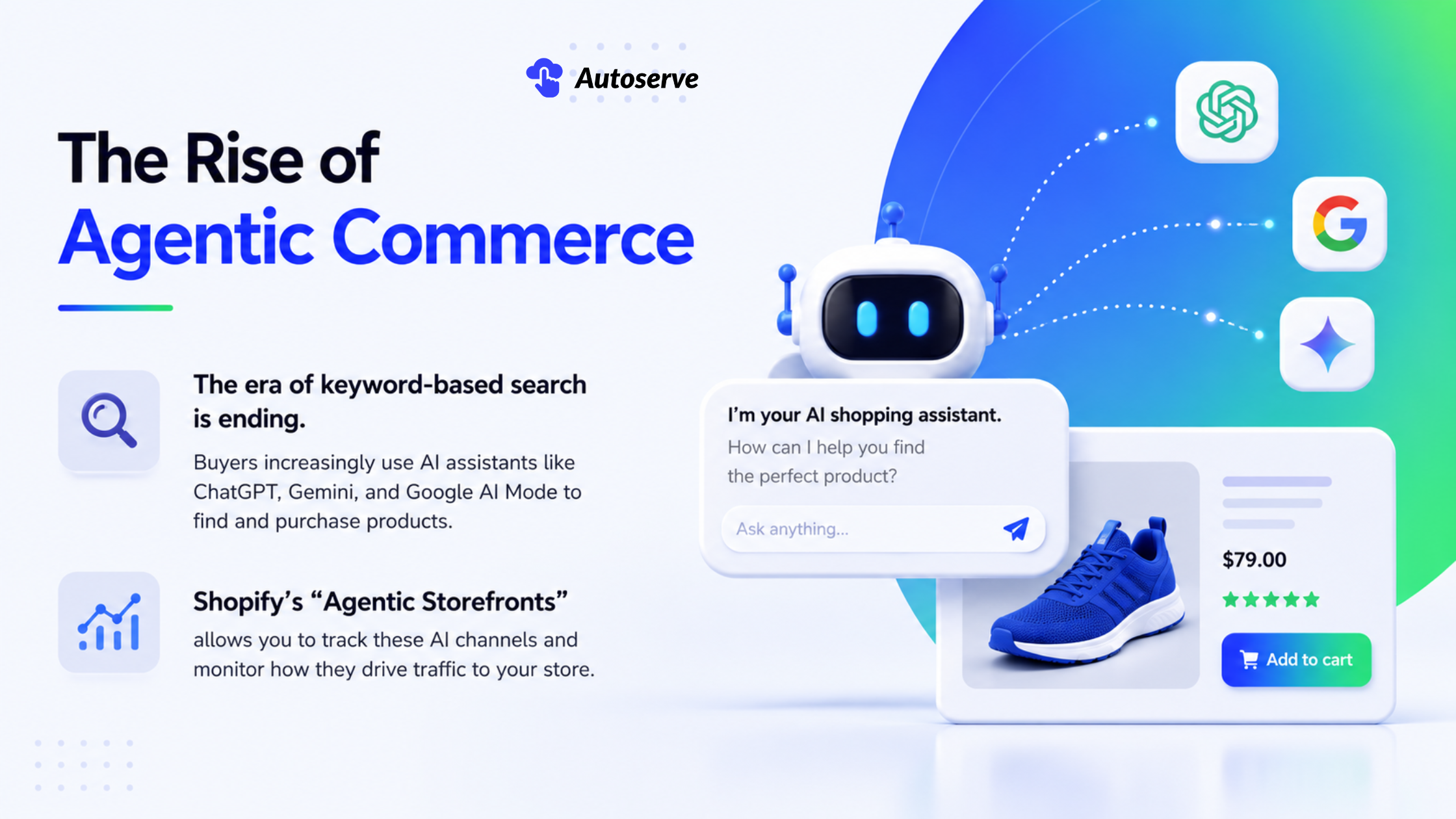
"Agentic commerce" is the term for AI systems that shop on behalf of users. A buyer might say to their AI assistant: "Find me a waterproof hiking backpack under $120 that ships in two days." The AI scans merchant catalogs, compares options, and presents a shortlist or completes the purchase autonomously.
Shopify's Agentic Storefronts feature is your gateway into this channel. It gives merchants a dedicated home in the Shopify admin to monitor AI-channel discovery, track which AI assistants are sending traffic, and optimize product data for better AI visibility. Early adopters who structure their product data correctly will dominate these new discovery surfaces.
The merchants who dismiss agentic commerce as "too early" are the same ones who ignored mobile optimization in 2012. The window to get ahead of the curve is still open but it is closing.
Shopping assistants powered by large language models (LLMs) are already influencing billions of buying decisions. A 2024 Salesforce survey found that 17% of all online orders already involve AI in some part of the discovery or decision process. By 2026, that number is projected to exceed 30% (Salesforce, State of Commerce, 2024).
For Shopify merchants, this creates an urgent content and data challenge. AI assistants recommend products based on how well-structured and semantically rich your product metadata is. Thin titles, vague descriptions, and missing attributes make your products invisible to AI recommendation engines.
Shopify has been quietly building one of the most comprehensive AI toolkits in ecommerce. The platform's 2025–2026 Changelog is packed with AI-first updates that most merchants have not fully explored yet. Here is what changed and why it matters for your bottom line.
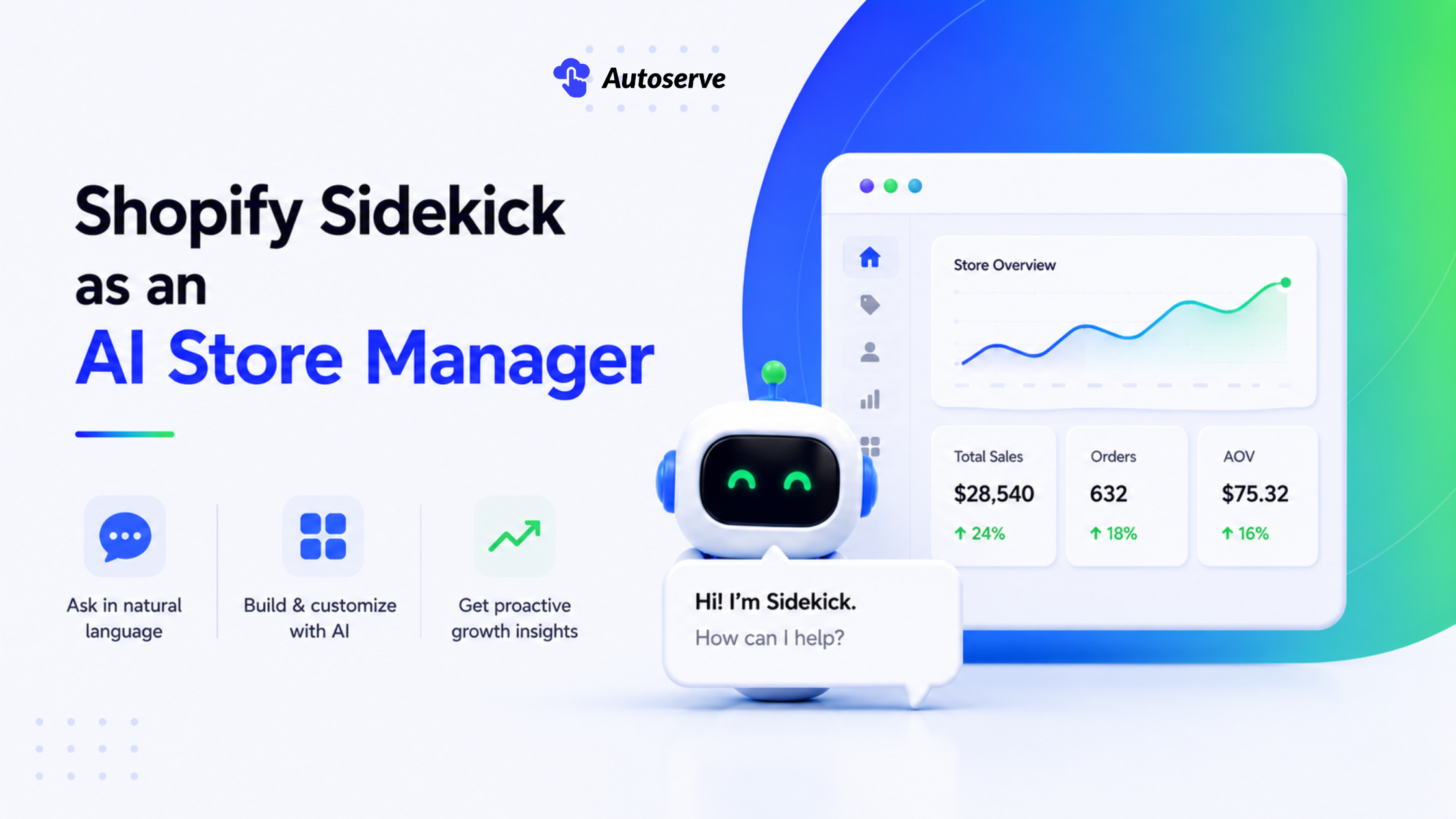
Shopify Sidekick is not just a chatbot. It is a function-calling AI agent that reads your live store data and can execute real actions with your approval. Think of it as an AI-powered store manager that never sleeps.
The most important Sidekick updates from the 2025–2026 Changelog include:
• Natural-language admin tasks: Ask Sidekick to create discounts, update product collections, or pull performance reports using plain English.
• Sidekick Pulse: A proactive recommendation engine that surfaces growth opportunities based on your store data before you even think to ask.
• Voice mode and mobile support: Manage your store hands-free from a mobile device.
• Custom app generation: Sidekick can now draft basic Shopify app code for custom workflows, reducing reliance on developers.
• Screen sharing: Sidekick can guide you through complex tasks step by step while viewing the same screen you see.
One critical distinction: Sidekick is for store management only. It cannot talk directly to your customers. For customer-facing AI, you will need a third-party app or a dedicated support tool a common point of confusion that many competing articles fail to clarify.
The updated Shopify Analytics Home is a significant upgrade for data-driven merchants. The dashboard now surfaces trends, sales streaks, and top-performing products automatically without requiring custom reports or ShopifyQL queries.
Key improvements include:
• Trend and streak detection: The dashboard flags when you are on a winning streak (three or more consecutive days of above-average sales) or when a metric is trending down.
• Top performer spotlights: Automatically highlights your best products, channels, and customer segments.
• Sidekick-powered data queries: Ask Sidekick in natural language "Which products drove the most revenue last month?" and get an instant chart.
For time-constrained merchants who cannot afford a full-time analyst, this is a game-changer. Decisions that used to require an hour of report-building now take seconds.
AI's most direct commercial impact is on revenue. When deployed correctly, AI tools on Shopify can increase average order value, improve conversion rates, and reduce cart abandonment. Here is how each mechanism works.
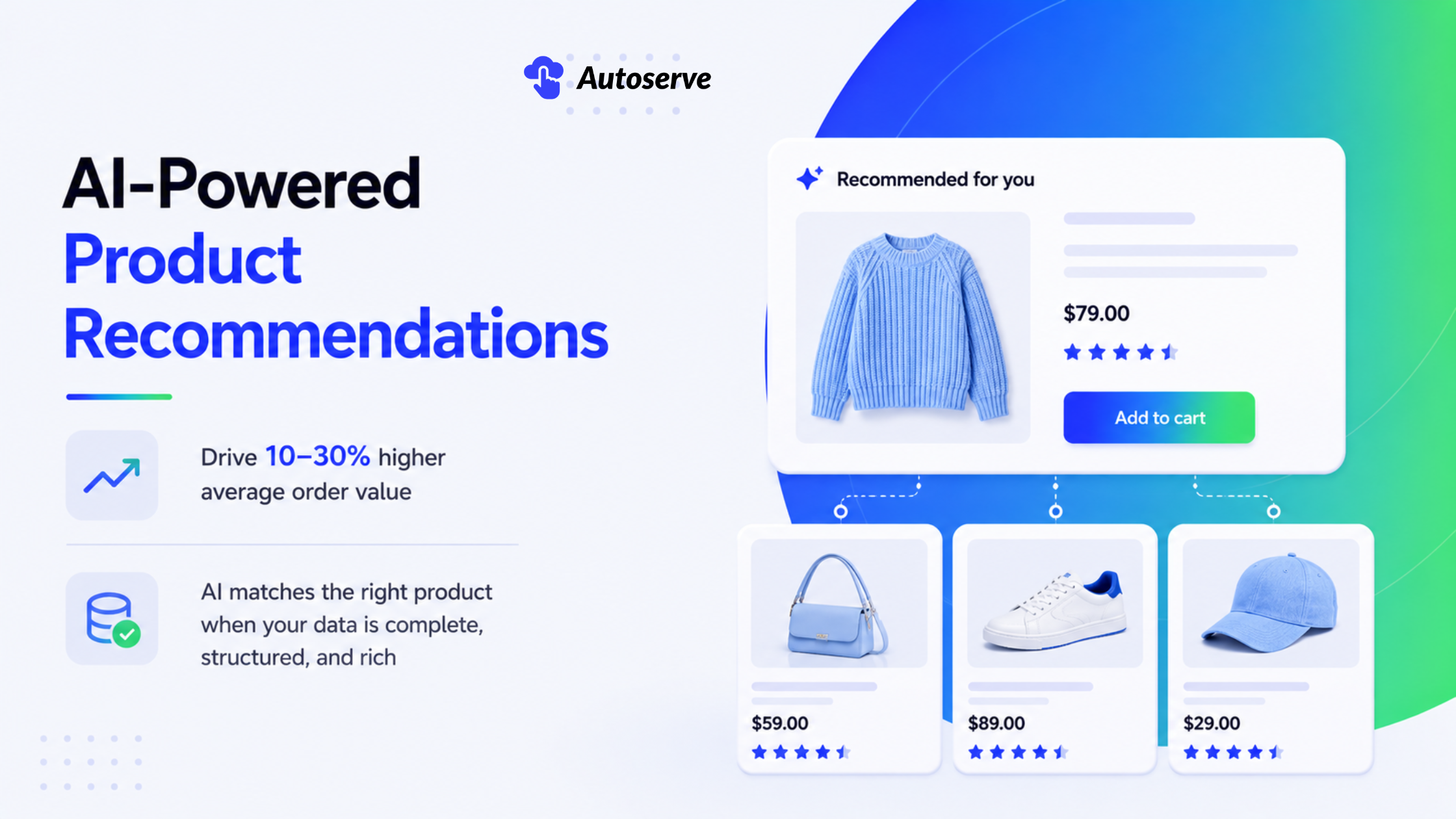
Personalized product recommendations are no longer a "nice to have." Research from McKinsey shows that 35% of Amazon's revenue comes from its recommendation engine. For Shopify merchants, AI-powered recommendations can replicate this effect at scale.
Shopify's native recommendation engine uses collaborative filtering and behavioral signals to suggest relevant products. Third-party apps like LimeSpot, Frequently Bought Together, and Rebuy extend this with deeper personalization. The revenue impact is measurable: merchants who implement AI recommendations consistently report 10–30% increases in average order value (AOV).
The key is ensuring your product catalog is structured for AI interpretation. Products with complete metadata, titles, descriptions, tags, and attributes, perform significantly better in recommendation algorithms than products with thin or inconsistent data.
Product data quality is the hidden variable that determines your AI upsell and cross-sell performance. AI systems both Shopify-native and external assistants like ChatGPT read your product metadata to understand what you sell, who it is for, and how it relates to other products.
A product with a title like "Blue Jacket" will underperform against a product titled "Men's Waterproof Shell Jacket Windproof, Packable, Sizes S–XXL." The second version gives AI systems the semantic context they need to match your product to the right buyer at the right moment.
Practical product data checklist for AI-readiness:
• Titles: Include key attributes (material, use case, audience, size range).
• Descriptions: Use natural language, not keyword strings. Answer the buyer's real question.
• Tags: Structured, consistent, and semantic ("waterproof," "hiking," "men's," not "wp" or "hik").
• Attributes: Fill every available metafield. AI assistants use structured attributes to filter and rank.
• Images: Alt text that describes the product accurately and completely.
This is a content gap most competitor articles miss entirely. They discuss AI trends but never explain the direct link between product data quality and AI-channel revenue performance.
Cart abandonment remains one of ecommerce's biggest revenue leaks, with an average rate of 70% across all devices (Baymard Institute, 2024). AI is now being used to close that gap in three specific ways.
First, predictive exit-intent: AI models trained on session behavior can identify when a shopper is about to abandon and trigger a personalized nudge a discount, a social proof element, or a shipping guarantee at exactly the right moment.
Second, AI-assisted checkout forms: Autofill, smart address validation, and friction-reduction tools that adapt to user behavior reduce the effort required to complete a purchase.
Third, post-abandonment personalization: AI-powered email and SMS flows that reference the exact product the customer abandoned including dynamic pricing or inventory urgency outperform generic cart recovery sequences by 3–5x.
Time is a Shopify merchant's scarcest resource. AI automation does not just save money, it frees up hours every week for the high-leverage work that actually grows your business. Here is how to build an AI-powered operations stack without a development team.
Shopify Flow is the platform's native automation builder. While it predates the current AI wave, its 2025–2026 updates have made it significantly more powerful and more accessible to merchants without technical backgrounds.
The most impactful Flow automations for AI-era merchants include:
• Intelligent order routing: Automatically assign orders to the closest fulfillment center based on inventory levels and shipping zones.
• Smart customer tagging: Tag customers by purchase behavior, LTV tier, or product affinity for segmented marketing.
• Automated reporting triggers: Flow can send a Slack or email alert the moment a KPI crosses a threshold no manual dashboard checking required.
• Inventory alert workflows: Get notified when a top-seller drops below reorder threshold, and optionally trigger a purchase order automatically.
Used with Sidekick's natural-language query capabilities, Flow becomes part of a closed-loop AI management system: Sidekick surfaces the insight, and Flow executes the response.
Inventory forecasting has historically been one of the most painful parts of running a Shopify store. Buy too much and you are stuck with deadstock. Buy too little and you miss sales. AI is changing this calculus significantly.
AI-powered demand forecasting tools including integrations available through the Shopify App Store use historical sales data, seasonal patterns, marketing calendar inputs, and external signals (like Google Trends data) to predict demand with significantly higher accuracy than manual forecasting.
Merchants who have adopted AI forecasting report up to 30% reductions in overstock and a 15–20% decrease in stockout events. For a store doing $1M in annual revenue, that can translate to $50,000–$150,000 in recovered revenue or freed capital annually.
This is the section that most AI ecommerce articles never write. They list trends. They explain features. But they rarely connect the dots: Trend → Shopify Feature → Use Case → Revenue Outcome. Here is that map.
Use this four-step framework every time you evaluate a new AI tool or trend for your Shopify store:
• Step 1: Identify the trend: What is changing in buyer behavior, discovery, or commerce technology?
• Step 2: Find the Shopify-native feature: Does Shopify already have a built-in tool to address this trend? (Usually yes.)
• Step 3: Define your use case: How does this feature apply specifically to your products, your audience, and your store's current bottleneck?
• Step 4: Measure the revenue outcome: What KPI will you track? AOV? Conversion rate? AI-channel traffic? Set a baseline before you start.
This framework prevents the most common merchant mistake: adopting AI tools without a clear measurement plan, then abandoning them because "they didn't work" when the real problem was a lack of baseline measurement.
This is one of the most critical and most underexplored topics in AI ecommerce. If ChatGPT or Google AI Mode is sending buyers to your store, you need to know about it and Shopify now makes it possible.
Shopify's Agentic Storefronts feature includes AI referrer attribution. When a customer arrives at your store via an AI channel, Shopify logs the source. You can view AI-channel traffic, session behavior, and conversion rates in your Analytics dashboard.
To set this up correctly:
• Enable Agentic Storefronts in your Shopify admin under Sales Channels.
• Review your AI-channel referrer data in Shopify Analytics under Traffic Sources.
• Monitor which AI assistants are sending the highest-converting traffic.
• Optimize product data for the AI assistants driving the most revenue.
This attribution data is pure gold. It tells you exactly which AI trends are translating into real sales, not just impressions or sessions.
Customer support is one of the highest-cost, most time-consuming functions for small Shopify teams. AI is changing what is possible and what is expected in post-purchase experience.
Modern AI customer support tools can resolve a surprisingly large percentage of support tickets without human involvement. The most common automatable support categories for Shopify merchants include:
• Order status inquiries: "Where is my order?" accounts for 30–40% of all support tickets for most merchants. AI can answer this in real time using order tracking data.
• Return and refund requests: AI tools can qualify requests, issue return labels, and initiate refunds based on your policy rules without human approval for straightforward cases.
• FAQ responses: Shipping times, product dimensions, care instructions, and compatibility questions are all automatable.
• Post-purchase follow-up: AI can send proactive delivery updates, satisfaction check-ins, and review requests.
Important clarification: Shopify Sidekick cannot interact with your customers. It is a merchant-facing tool only. For customer-facing AI support, you will need a dedicated tool like Tidio, Gorgias AI, or Richpanel.
The financial case for AI customer support is compelling. Traditional support costs $5–$25 per ticket when handled by a human agent. AI-powered resolution costs less than $0.50 per ticket at scale. For a merchant receiving 500 support tickets per month, that is a potential saving of $2,000–$12,000 monthly.
Beyond cost, speed is the bigger retention driver. Research from Zendesk shows that customers who receive a response within one hour are 7x more likely to make a repeat purchase than those who wait 24+ hours. AI support tools respond in seconds, 24 hours a day, seven days a week.
The retention loop is clear: faster resolution → higher satisfaction → lower churn → higher lifetime value. For a merchant with 5,000 active customers and a $150 average LTV, even a 5% improvement in retention represents $37,500 in additional revenue.
Learning from mistakes is valuable. Learning from other people's mistakes is faster. Here are the three AI implementation errors that are hurting Shopify merchants most in 2026 and how to avoid them.
If your products are not discoverable by AI assistants, no other AI investment will save your store. AI recommendation engines, agentic shopping assistants, and Shopify's own native tools all depend on structured, complete product data to function effectively.
Thin metadata is the single biggest reason Shopify merchants are invisible on AI channels. A product with a one-sentence description and three tags will never rank in ChatGPT's recommendations ahead of a competitor product with a rich, semantically complete description and 20 well-chosen attributes.
Minimum viable metadata checklist:
• Product title includes category, key attribute, and audience.
• Description answers the top three buyer questions for this product type.
• At least 10 relevant, specific tags applied.
• All available metafields completed.
• Image alt text describes the product, not just the filename.
Generic AI tools standalone ChatGPT wrappers, disconnected automation platforms, off-the-shelf chatbots cannot access your live Shopify data. They cannot check your real-time inventory. They cannot read your actual order history. They cannot execute actions in your Shopify admin.
Shopify-native tools like Sidekick and Flow operate directly on your store's live data via Shopify's APIs. This is a fundamental architectural advantage that generic tools cannot replicate.
The practical implication: before subscribing to any third-party AI tool, check whether Shopify already offers a native equivalent. Native tools are faster to implement, cheaper to maintain, and far more powerful because they have direct data access.
Automation is powerful, but untested automation is dangerous. Merchants who build complex Flow workflows without adequate testing risk triggering conflicting rules, sending incorrect customer communications, or creating inventory logic errors that are difficult to trace.
Common over-automation symptoms:
• Customers receiving duplicate or contradictory order notifications.
• Discounts being applied incorrectly due to overlapping trigger conditions.
• Inventory levels going negative because reorder flows fire multiple times.
The solution is simple: test every workflow on a staging environment or with a test order before activating it in production. Audit your active flows quarterly. And apply the principle of minimum viable automation automate one step at a time, measure the outcome, then expand.
You have read the trends. You understand the tools. Now it is time to act and the merchants who act first will have a meaningful head start.
Here is your 30-minute AI quick-start checklist for Shopify:
• Enable Agentic Storefronts in your Shopify admin. It is free and takes two minutes. Start tracking your AI-channel presence today.
• Open Shopify Sidekick and ask: "What are my top 5 products by revenue this month, and what is their conversion rate?" You will be surprised what you learn in the first five minutes.
• Run a product data audit on your top 20 SKUs. Use the metadata checklist above. Enrich titles, descriptions, and tags for semantic completeness.
• Build one Flow automation start with the low-stock reorder alert. It is the fastest ROI automation for most stores.
• Set a 30-day AI attribution benchmark. Record your current AI-channel traffic in Shopify Analytics today. In 30 days, measure the change.
Every major shift in ecommerce has created a window where early movers captured disproportionate market share. Mobile-first. Social commerce. Email automation. Each time, the merchants who moved early won. AI commerce is that same window but it is moving faster than any previous shift.
The question is not whether AI will reshape your Shopify store. It already is. The question is whether you are shaping it intentionally or letting it happen to you.
Sidekick's core features are available on all Shopify plans. Advanced capabilities including Sidekick Pulse and custom app generation are currently gated to Advanced and Plus plans as of 2026.
ChatGPT has no access to your live store data and cannot execute actions in your Shopify admin. Sidekick is a function-calling AI agent built on Shopify's APIs, it can read your real data and take real actions with your approval.
No. AI augments human judgment rather than replacing it. AI handles repetitive, data-driven tasks efficiently, but strategic decisions, brand voice, and complex customer situations still require human expertise.
Run this quick readiness check: Is your product data complete and structured? Do you have at least 90 days of sales history in Shopify Analytics? Have you explored Shopify Flow? If yes to all three, you are ready to activate AI features immediately.
Agentic Storefronts combined with product data optimization delivers the highest ROI for small merchants because it improves AI-channel discoverability with no ongoing cost — just a one-time setup and regular catalog maintenance.
We try to make easy and simple for every professionals. Get 30 days free trial - No credit card required.

