🎉 Calla - Delivery & Pickup Date is available now on Shopify app store

Shopify app store


Your restaurant tables are empty at noon, but a competitor three blocks away is fully booked. They spend less on ads. They use a smarter local PPC strategy and right now, you probably do not.
Most restaurant owners burn ad budget on people who are twenty miles away, not hungry yet, or already eating somewhere else. Google Ads, done wrong, is a very fast way to lose money. Done right, it fills your dining room during every service window.
This guide shows you exactly how to build a local PPC strategy for restaurants from picking the right platformand keywords to structuring campaigns that convert nearby diners into real reservations, calls, and walk-ins. Whether you run one location or fifty, the same framework applies.
A local PPC strategy for restaurants is a paid search system designed to reach diners within a defined distance of each location, at the moment they are actively searching for a place to eat. Unlike broad brand campaigns, local PPC targets geography, time, and intent simultaneously.
The core idea is simple: when someone searches "Italian restaurant open now near me" on their phone, your ad should appear, link to a fast mobile landing page, and offer a clear reason to choose you a menu preview, a lunch special, or a one-click reservation button. Every element of the campaign works together to close that gap between search and seat.
Restaurant demand is deeply local. A 2023 Think with Google study found that 76 percent of people who search for something nearby on their smartphone visit a related business withinone day, and 28 percent of those searches result in a purchase. That search to visit window is your competitive advantage if your campaign is structured to capture it.
Before you set a single budget or write a single ad, decide what action you want diners to take. This choice drives every other decision in your campaign, your landing page, your ad extensions, your conversion tracking setup, and how you measure ROI.
The four primary conversiongoals for restaurant PPC are:
Phone calls: Ideal for quick service and casual dining where customers confirm hours, ask about specials, or place orders.
Reservations: Critical for full service, fine dining,and high-demand weekend slots; connect ads directly to OpenTable, Resy, or your own booking system.
Direction clicks: Valuable for walk-in traffic; Google Maps ads and location extensions drive this conversion type automatically.
Online orders: Essential for delivery or takeout-focused restaurants; link ads to your ordering platform or a dedicatedorder page.
Most restaurants need two or three of these goals active at once, but they should not all live in the same campaign. Separate campaigns by conversion goal. A campaign optimized for reservation clicks uses a different bidding strategy, ad copy, and landing page than one optimized for phone calls. Mixing them dilutes performance data and makes optimization impossible.
Restaurants live and die by meal windows. Breakfast, lunch, and dinner each attract different search behaviors, different devices, and different levels of purchase intent. A generic always-on campaign wastes money between service windows and under spends during peak hours.
Ad scheduling also called dayparting is one of the highest-ROI levers in restaurant PPC. Data from WordStream's restaurant industry benchmark report shows that click-through rates for food related Google Ads are significantly higher during the 11am–1pm lunch window and the 5pm–8pm dinner window compared to off peak hours. Scheduling your budget to concentrate during these windows can reduce cost per click and increase conversion rate at the same time.
Visual performance matters too, especially on the Google Display Network and in responsive search ads. Ads that feature real food photography not stock images consistently out performgeneric visuals. According to research from Tapad and Nielsen, food related ads with authentic imagery drive up to 30 percent higher engagement than text only or stock photo alternatives. Use real photos of your best dishes in every display or Performance Max asset group.
Device type is another timing factor. Mobile accounts for over 60 percent of restaurant-related searches, according to Google's own industry data. Your bid adjustments should reflect this: increase mobile bids by 20–40 percent during peak meal windows, and ensure every landing page loads in under three seconds on a mobile connection.
Not all PPC platforms deliverthe same results for restaurants. The right choice depends on your conversion goal, your customer profile, and whether you are targeting new diners or re-engaging existing ones. The three platforms that matter most for restaurant local PPC are Google Search Ads, Google Maps ads, and remarketing campaigns each serving a different role in your acquisition funnel.
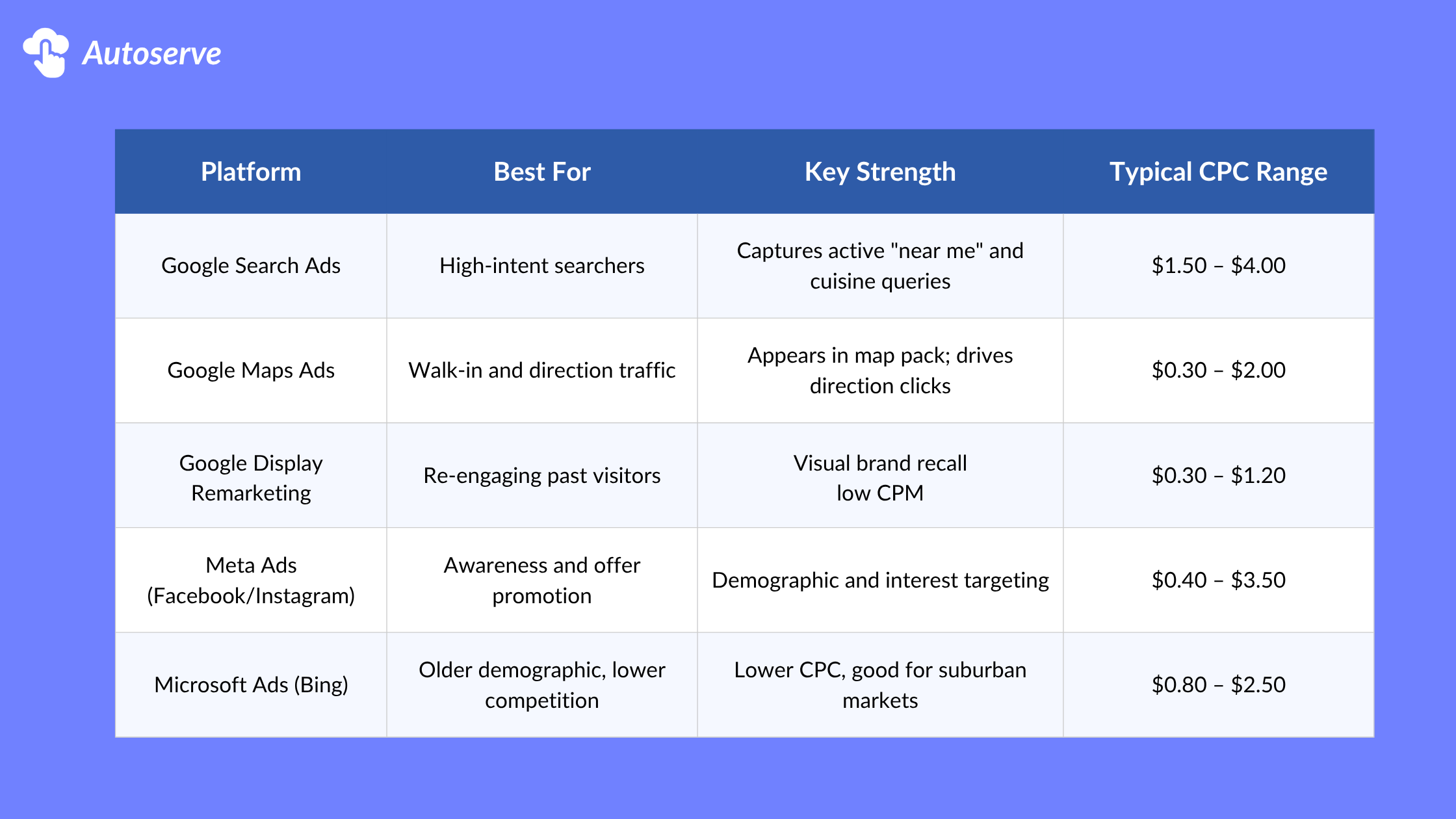
CPC ranges are estimates from WordStream and Google Ads benchmarks (2023–2024). Actual costs vary by market, competition, and quality score.
Google Search Ads are thefoundation of any restaurant local PPC strategy. They appear at the exact moment someone types a high intent query "sushi restaurant downtown", "best brunch near me open now", "cheap lunchdeals [city]". No other platform captures this demand at the same scale.
Use Google Search Ads as your primary campaign type when your main goal is reservations, phone calls, or direction clicks from new customers. The campaign structure that performs bestfor single location restaurants follows a three campaign model:
1. Brand campaign protects your brand name from competitors bidding on it; low spend, high conversion rate.
2. High-intent local campaign targets "[cuisine] restaurant near me", "[city] restaurant", and offer-based queries; this is your main acquisition engine.
3. Competitor campaign targets searches for competitor names in your area; use carefully and only when margins support the higher CPC.
For multi-location restaurants, replicate this structure per location. Use separate campaigns not ad groups for each location. This gives you independent budget control, location specificad copy, and clean performance data. Mixing locations inside a single campaign makes it impossible to optimize each store individually.
Quality Score is everything in Google Ads. A higher Quality Score means a lower cost-per-click and better adposition. To maximize it, ensure tight keyword to ad copy alignment, use location specific landing pages, and maintain a fast mobile experience. A restaurant that achieves a Quality Score of 8–10 on its core keywords can pay 30–50 percent less per click than a competitor with a score of 4–5, even bidding lower.
Google Maps ads officially called Local Search Ads are one of the most unde rused tools in restaurant PPC. They appear inside the Google Maps interface when someone searches forrestaurants in a specific area, placing your pin at the top of the map pack with a sponsored tag. For restaurants with strong walk-in traffic, Maps ads are often the highest-ROI campaign type in the account.
To run Maps ads, link your Google Ads account to your Google Business Profile. Set up location extension sand enable location targeting at the campaign level. Maps ads are billed on a cost per click basis, with clicks counting when someone taps for directions, calls your location, or views your menu. Because these users are already innavigation mode, conversion rates are significantly higher than standard search ads.
Remarketing campaigns serve adifferent purpose: they re-engage people who already visited your website or interacted with your ad but did not convert. For restaurants, a remarketing audience might include people who viewed your reservation page but did not complete a booking, or people who visited your menu page in the last 30 days. Awell structured remarketing campaign runs on the Display Network with a modestdaily budget of $5–$15 per location, using real food photography and a specific offer "Book your table this weekend and get a complimentary dessert" to drive the follow through.
High-intent keywords for restaurants fall into four categories. Each one signals a different stage of the "I want to eat" journey, and each warrants a specific ad message and landing page.
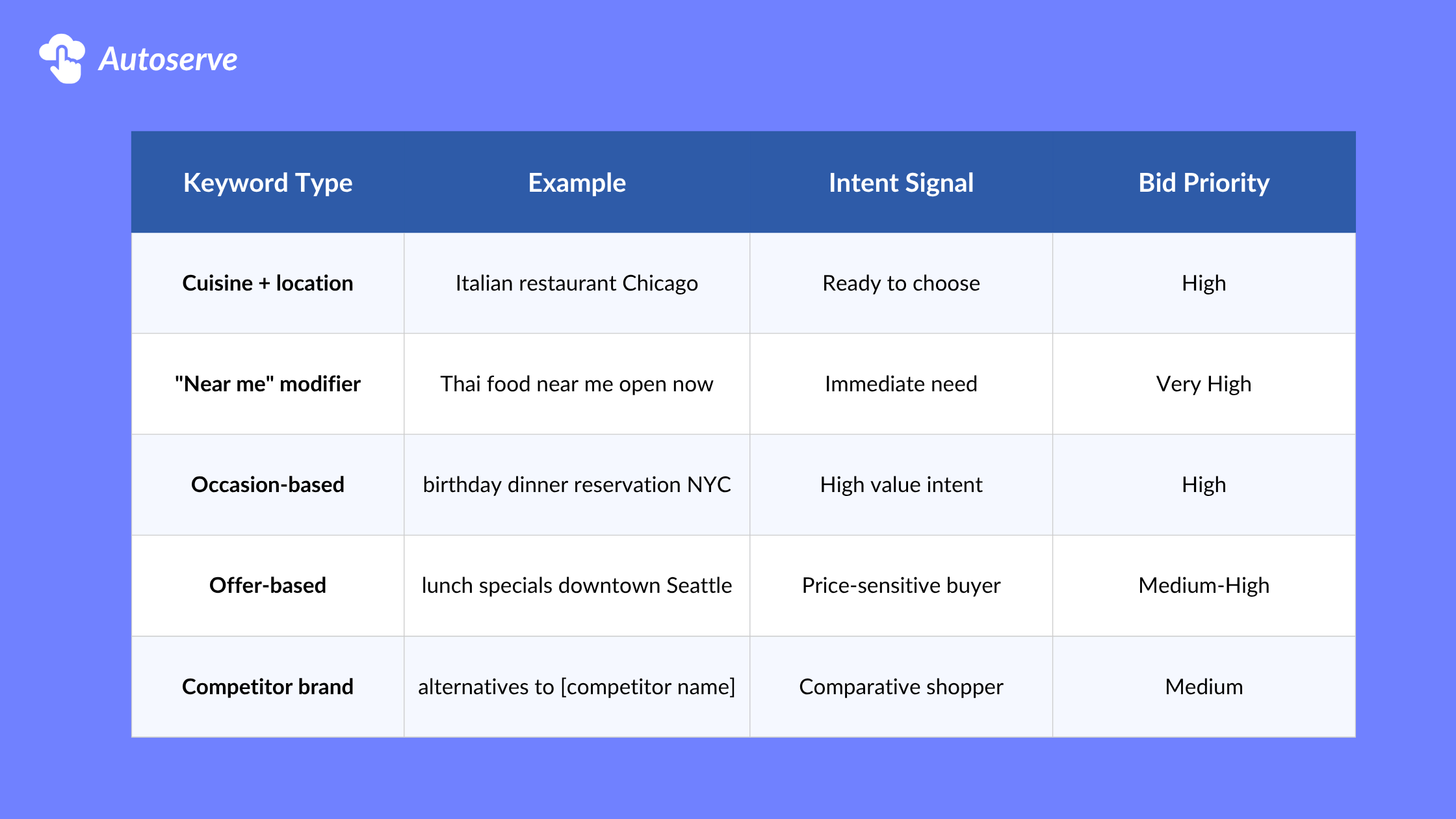
Regularly review your search terms report (at least weekly in the first month) and move performing queries to exact match. This is how you build a precision keyword list over time, reducing wasted spend with every optimization cycle.
Google's AI-powered targeting tools have matured significantly in recent years. Smart Bidding strategies Target CPA, Target ROAS, and Maximize Conversions use machine learning to adjust bids in real time based on signals that humans cannot process manually: device, time of day, location, search history, audience behavior, and more.
For restaurants, the most effective Smart Bidding strategy is Target CPA (cost per acquisition) once you have at least 30–50 conversions per month in a campaign. Before that threshold, use Maximize Conversions with a target CPA as a cap. This prevents overspending while letting the algorithm learn. Performance Max campaigns, which run across Search, Display, YouTube, Maps, and Gmail simultaneously, are worth testing formulti-location restaurants once you have strong creative assets and a verified conversion tracking setup.
Meta Ads (Facebook andInstagram) serve a different role than Google. They excel at reach andawareness promoting a new menu, a seasonal event, or a grand opening rather than capturing active purchase intent. For local restaurants, the most effective Meta strategy combines geo-targeting within a 5–10 mile radius, demographic targeting (age, income bracket, dining interest signals), and Instagram Stories or Reels with real food video. Meta's Advantage audience tool can expand targeting automatically to similar users, which works well for restaurants with an established customer base and a recognizable visual brand.
Wasted ad spend is the silent killer of restaurant PPC.
It happens when your ads show to people who are too far away to visit, who are searching for something unrelated, or who already visited and bounced from a slow landing page. Three tools eliminate most ofthis waste: negative keywords, remarketing to prior visitors, and promotional offers timed to off peak periods.
Remarketing and promotional campaigns for existing customers are among the most cost effective tactics available. A customer who already visited your website is 3–5 times more likely to convert than a cold audience, according to Google's own remarketing performancedata. Use RLSA (Remarketing Lists for Search Ads) to increase bids automatically when a past visitor searches for your category keywords. Even a 20 percent bid increase for this audience can significantly improve conversion volume at no extra cost.
Track all four core actions: phone call clicks, reservation form submissions, direction request clicks, andonline order completions. Without tracking all four, you cannot accurately calculate cost per acquisition or optimize bidding strategies.
Negative keywords block your ads from showing for irrelevant searches. For restaurants, essential negatives include job related terms, recipe and how to queries, out of area geography, and unrelated cuisine types. A well-maintained negative keyword list typicallyreduces wasted spend by 15–35 percent.
Yes. The local PPC is one area where small restaurants have a structural advantage. Large chains often usenational campaigns that are less geo-targeted and less specific. Awell-optimized local campaign with neighborhood keywords, accurate geo-targeting, and a fast landing page can outrank a chain's generic national ads at lowercost.
Every day your restaurant runs broad, unoptimized ads is a day you pay for clicks that never become covers.The framework in this guide conversion first campaign structure, geo-targeted keywords, peak hour scheduling, fast landing pages, and integrated tracking is what separates restaurants that grow with paid search from those that giveup on it.
The good news most of your competitors are still running generic campaigns. A properly structured local PPC strategy gives you an immediate and measurable edge in your own neighborhood. Ready to stop wasting local ad budget? Autoserve can help review your PPC Ads, local content, Instagram strategy, and customer engagement approach.
We try to make easy and simple for every professionals. Get 30 days free trial - No credit card required.

