🎉 Calla - Delivery & Pickup Date is available now on Shopify app store

Shopify app store


.png)
Most restaurants treat seasonal promotions as an after thought. They wait until two weeks before a holiday, scramble to write a few social posts, and wonder why tables stay empty. Sound familiar? You put in the work the recipes, the plating, the photos but the guests just don't show up. Here's the hard truth: the season is not your problem. Your campaign strategy is.
This guide shows you exactly how to promote seasonal menu items and how to plan seasonal restaurant campaigns that fill seats, grow check sizes, and build loyal regulars. Whether you run one location or manage a growing group, these tactics are tested, specific, and built for today's restaurant landscape.
Who this is for: Restaurant owners, general managers, and marketing managers who want a repeatable system not a one-off Instagram post.
Seasonal dishes create what behavioral economists call a "scarcity trigger."When guests know a dish is only available for a limited time, they act faster. They visit sooner, share more on social media, and order higher-priced itemsbecause the perceived value goes up.
A 2023 study by the National Restaurant Association found that 68% of consumers say they are more likely to visit a restaurant if it offers seasonal or limited-time menuitems. That's not a small margin. It's nearly seven out of ten potential guests making decisions based on your seasonaloffer.
Beyond traffic, seasonal items lift average check size. Guests who order a seasonal special are more likely to add a paired drink, a shareable appetizer, or a seasonal dessert. Menu engineering research from Cornell University's Centerfor Hospitality Research confirms that new, time-limited items attract attention and push guests toward higher-margin pairings.
• Seasonal LTOs (limited-time offers) generate 15–20%more social media mentions than standard menu items (Datassential, 2023).
• Restaurants with active seasonal campaigns report 12%higher revenue during promotional periods vs. non-campaign weeks (Toast POSdata, 2022).
• Guests spend an average of $4.50 more per visit when they order a seasonal special (Black Box Intelligence, 2023).
The psychology behind limited-time offers is well documented. Scarcity and urgency are two of the most powerful forces in consumer decision-making. When your guests see "available through October" or "only on weekends this month," their brain shifts from passive interest to active intent.
This is called loss aversion, thefear of missing out is stronger than the desire to gain something. Dr. Robert Cialdini's research on influence shows that scarcity consistently increase sperceived value and speeds up decision making. For restaurants, this means: a seasonal campaign with a clear end date will out perform an always available dish every time.
The key is communicating the scarcity clearly. Don't hide the deadline in small print. Putit front and center on your menu, your social posts, and your email subjectline. "Back for fall only until November 15" is more powerful than"try our new fall menu."
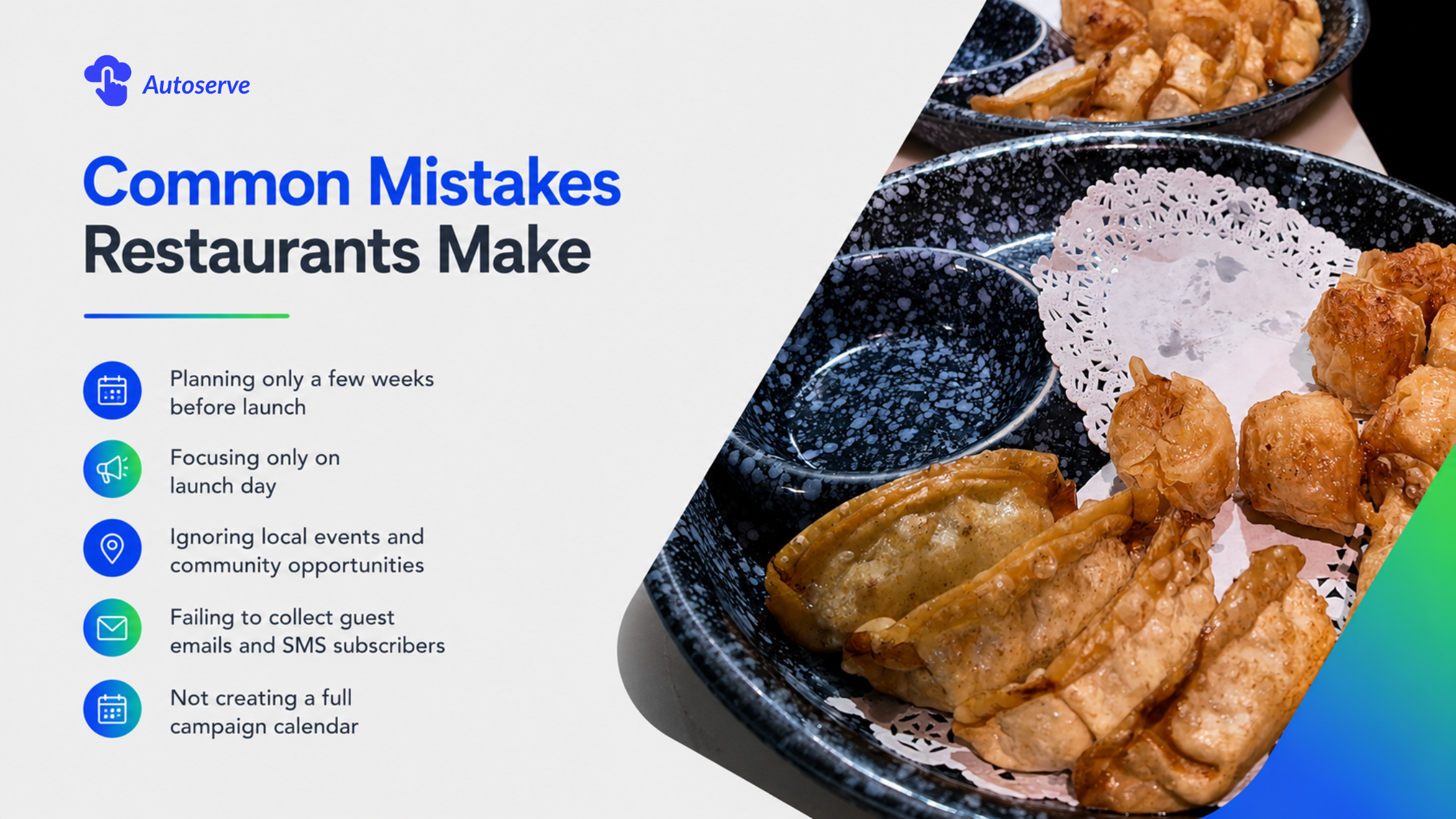
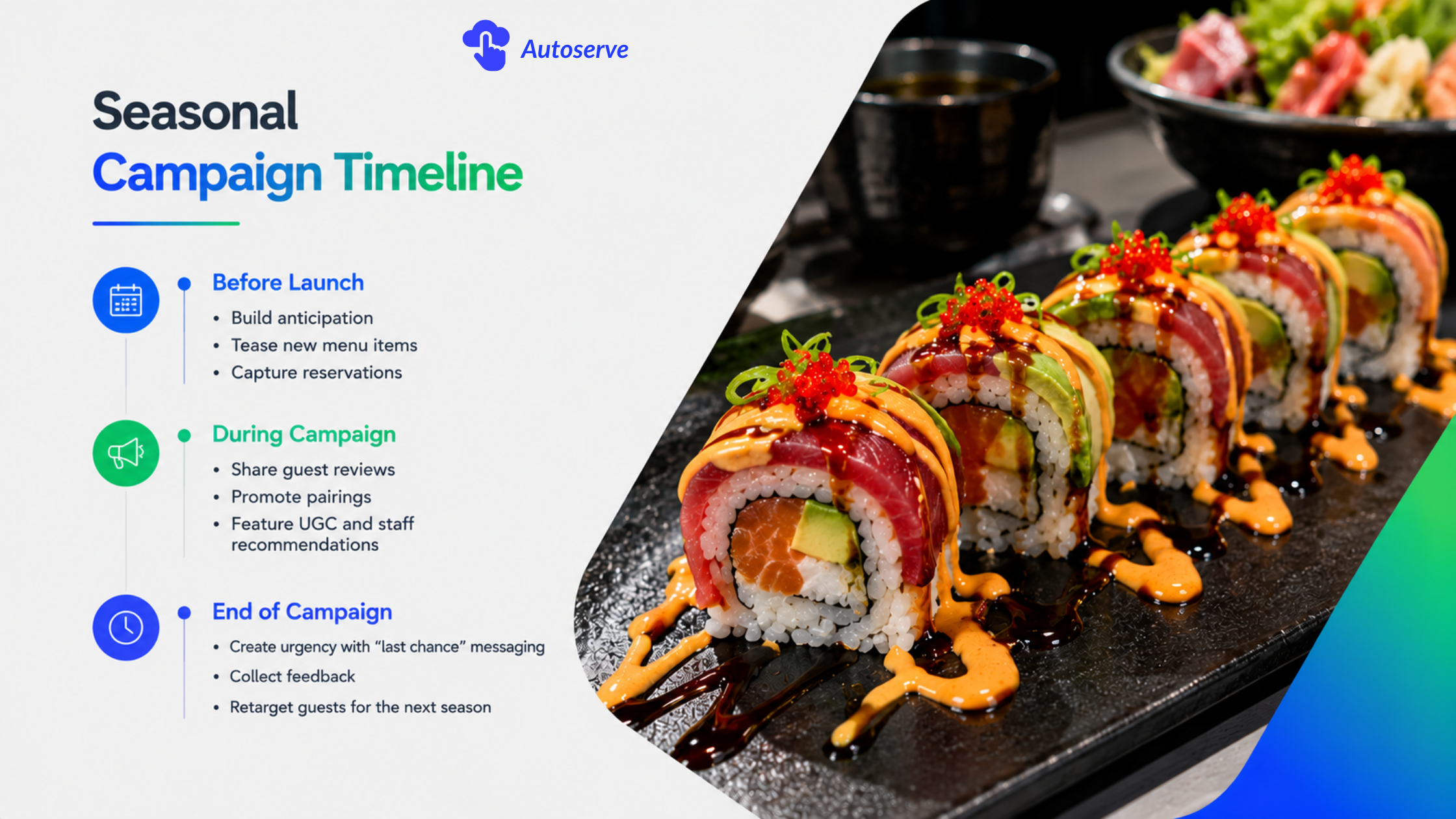
Most restaurants miss three big seasonal revenue windows: the pre-season buzzperiod, the mid-season momentum drop, and the end of season "last chance" surge. Almost everyone focuses on the launch day. Very few plan content and promotions for the six weeks in between.
The second missed opportunity is local event alignment. Your town's harvest festival, the school home coming weekend, or a local 5K race can all drive traffic but only if you've planned a campaign around them. Restaurants that align seasonal menus with local events see 20–30% higher traffic on those specific days (OpenTabledata, 2023).
Third, most restaurants don't collect guest data during seasonal campaigns. Every seasonal promotion is a chance to grow your email list, retarget guests with SMS offers, and build a database for next year's campaign. Miss this, and you're starting from scratch every season.
Every successful seasonal campaign starts with a specific goal not just "increase sales." Vague goals produce vague results. Before you design a single social post or update your menu board, answer these questions:
• What is your target revenue increase during the campaign period? (e.g, +15% week-over-week for 4 weeks)
• How many new guests do you want to acquire through this campaign?
• What is your target average check size during the promotion?
• What is your minimum margin on each new seasonal item?
Once you set a goal, work backward. If you want 200 extra covers over the campaign period, how many reservations, walk-ins, and takeout orders does that require per week? What marketing activity will drive each channel?
Use a simple campaign brief with five fields: goal, target audience, primary message, channels, and success metrics. This brief becomes your decision-making filter for every piece of content and spend throughout the campaign.
Pro tip: Seta baseline before you launch. Pull your average weekly revenue and cover count for the same period last year. That's your comparison point. Without a baseline, you can't know if the campaign worked.
Not every season is equal for every restaurant. A beachside seafood spot has a completely different seasonal calendar than a downtown steak house. The first step is identifying which seasons or occasions actually drive demand for your specific concept and guest base.
Map your seasonal opportunities in four categories:
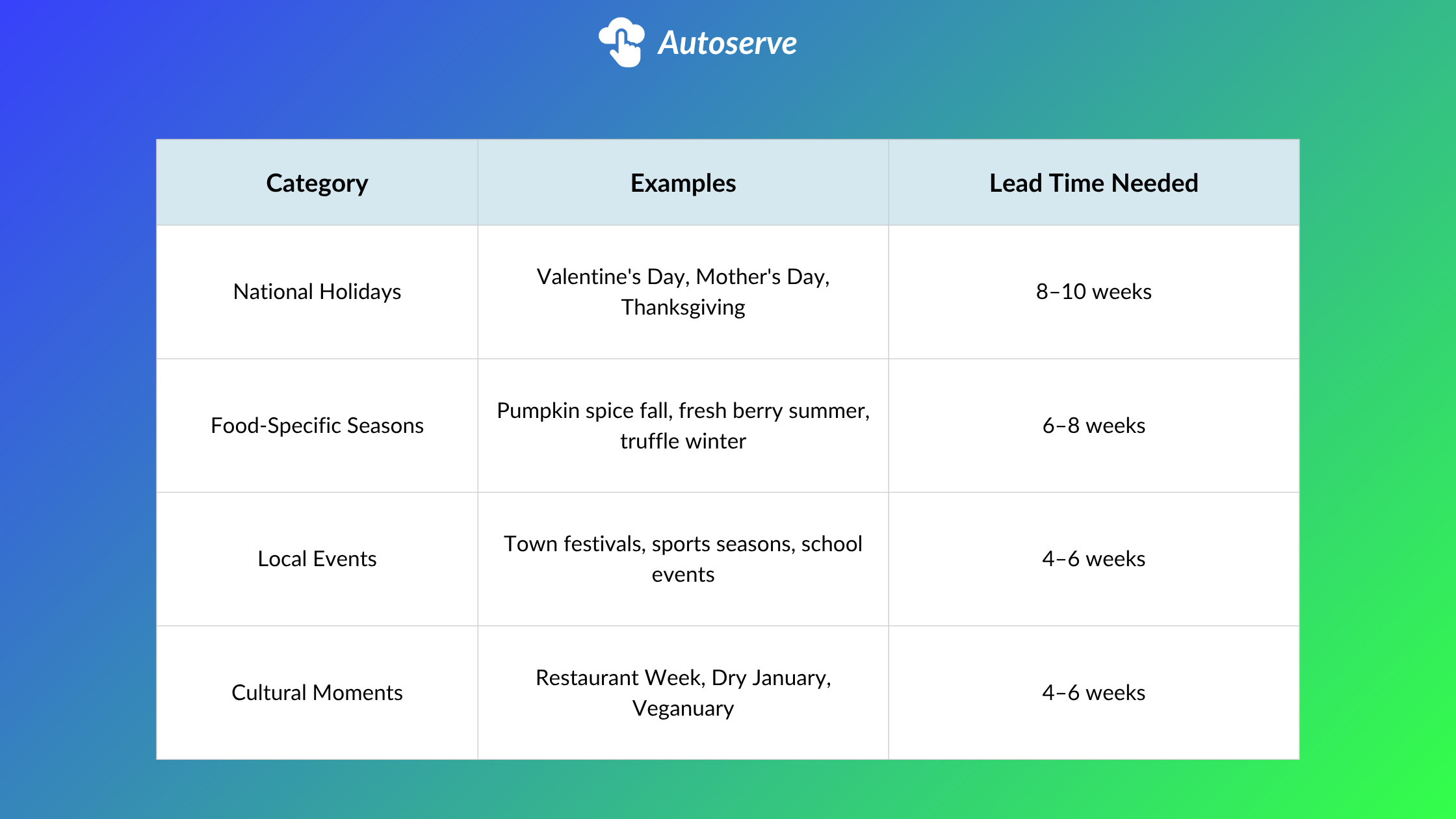
Choose your top three to four seasonal windows per year. Don't try to campaign every month. You'll exhaust your team anddilute the impact. Focus your energy where demand already exists, then amplifyit.
The best seasonal themes connect a menu item to a feeling, not just a date. "Cozyfall flavors" is a theme. "October menu" is not. Guests buy feelings, not calendar slots.
One of the most common mistakes restaurants make is planning too late. A well-executed seasonal campaign needs time for menu development, staff training, photo shoots, supplier ordering, and marketing build-up. Here is a practical timeline based on campaign size:
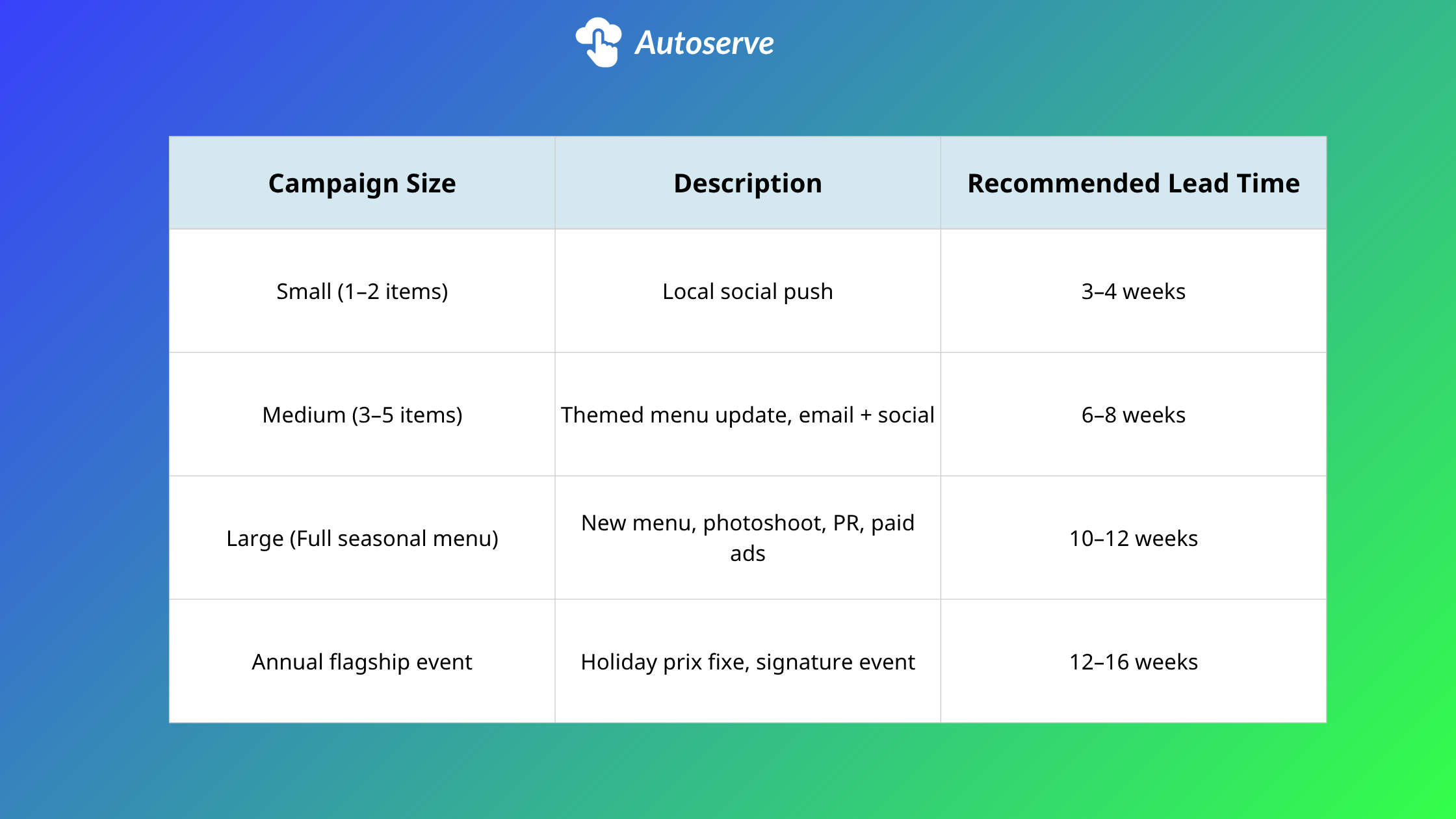
The most important pre-launch milestone is your photo and content shoot. Everything elsesocial posts, email graphics, menu updates, Google Business profile updates depends on having the right images. Schedule this shoot at least four weeks before launch, even for small campaigns.
The best seasonal menu items sit at the intersection of what guests already want and what your kitchen does well. Don't chase trends blindly but don't ignore them either. The goal is to find the overlap.
Start with your own data. Look at your POS for your top-selling dishes in the previous year's same season. What flavor profiles sold best? What proteins? What pricerange? This tells you what your specific guests not some hypotheticalnational average, actually want.
Then check trend data. Google Trends is free and powerful. Search for seasonal flavorterms ("butternut squash soup," "strawberry shortcake,""citrus chicken") and see what's rising vs. declining. Datassential's annual flavor forecast and the National Restaurant Association's What's Hot Chef Survey are both excellent benchmarks for menu planning.
Trending seasonal ingredients for U.S. restaurants in 2024–2025 (per Datassential Menu Trends):
• Fall/Winter: Miso-glazed proteins, brown butter sauces, pomegranate, chestnuts, cardamom
• Spring/Summer: Yuzu, charred citrus, fresh herbs (shiso, Thai basil), white peach, cucumber-forward cocktails
• Year-round rising: Korean BBQ flavors, fermentedcondiments, plant-based proteins with seasonal produce
Everyseasonal item needs a profitability check before it goes on the menu. Menuengineering, developed by professors Donald Smith and Michael Kasavana at Michigan State University, gives you a four-quadrant framework to evaluate every dish.
For seasonal items, aim for a food cost percentage between 28–32%. Use your supplier relationships to lock in pricing on seasonal ingredients before you finalize your menu. Volatile produce prices can turn a profitable seasonal dish into a margin killer mid-campaign.
Write menu descriptions that sell the experience, not just the ingredients. "Slow-braised short rib with roasted butter nut squash and herb gremolata" outsells "beef short rib with squash" and it justifies a higher price point. Cornell research shows that evocative menu language increases item sales by up to 27%.
A seasonal menu that excites guests but breaks your kitchen team is not a success. Before finalizing any new item, run it through a practical feasibility filter:
• Can your team execute this dish during a Saturday dinner rush without slowing ticket times?
• Does it require a unique ingredient with uncertain supply or high price volatility?
• Does it require special equipment or skills your team doesn't currently have?
• How does it interact with your existing prep schedule and storage capacity?
The best seasonal items share components with your existing menu. A fall risotto that uses the same roasted mushrooms as your current side dish saves prep time and reduces waste. Cross-utilization is the hidden secret of profitable seasonal menus.
Test every new item in a soft launch before the campaign goes live. Run it as a staff meal, then as a chef's special for one week. Gather real feedback on execution time, portion size, and guest response before you commit to a full campaign behind it.
Not all dates on the calendar are worth a full campaign. Prioritize your seasonal marketing calendar using two filters: national demand spikes and local relevance to your community.
• Mother's Day (consistently the #1 restaurant day in theU.S.)
• Valentine's Day (#2, especially for dinner-focusedconcepts)
• Thanksgiving Eve / "Blackout Wednesday"(top-3 bar and casual dining night)
• New Year's Eve (#1 for prix fixe and event dining)
• Father's Day and Easter Sunday (strong for brunch andfamily dining)
For local relevance, survey your existing guests. A simple question in your email newsletter. "What local events or times of year do you most want to celebrate with us?" gives you data that no national report can provide.
Choose three to four national dates and two to three local dates per year as your"campaign-worthy" occasions. Everything else can be handled with lighter-touch social content rather than a full campaign push.
A seasonal campaign is not a single event, it's a three-phase arc. Most restaurants only execute the launch phase, whichis why they leave so much revenue on the table. Here is the full campaign arc:
.png)
The"wrap + retargeting" phase is where most restaurants drop the ball. A simple email to guests who visited during the season. "You loved our fall menu. Our winter launch is coming soon. Get early access here" can generate reservations before you've even finalized the new menu.
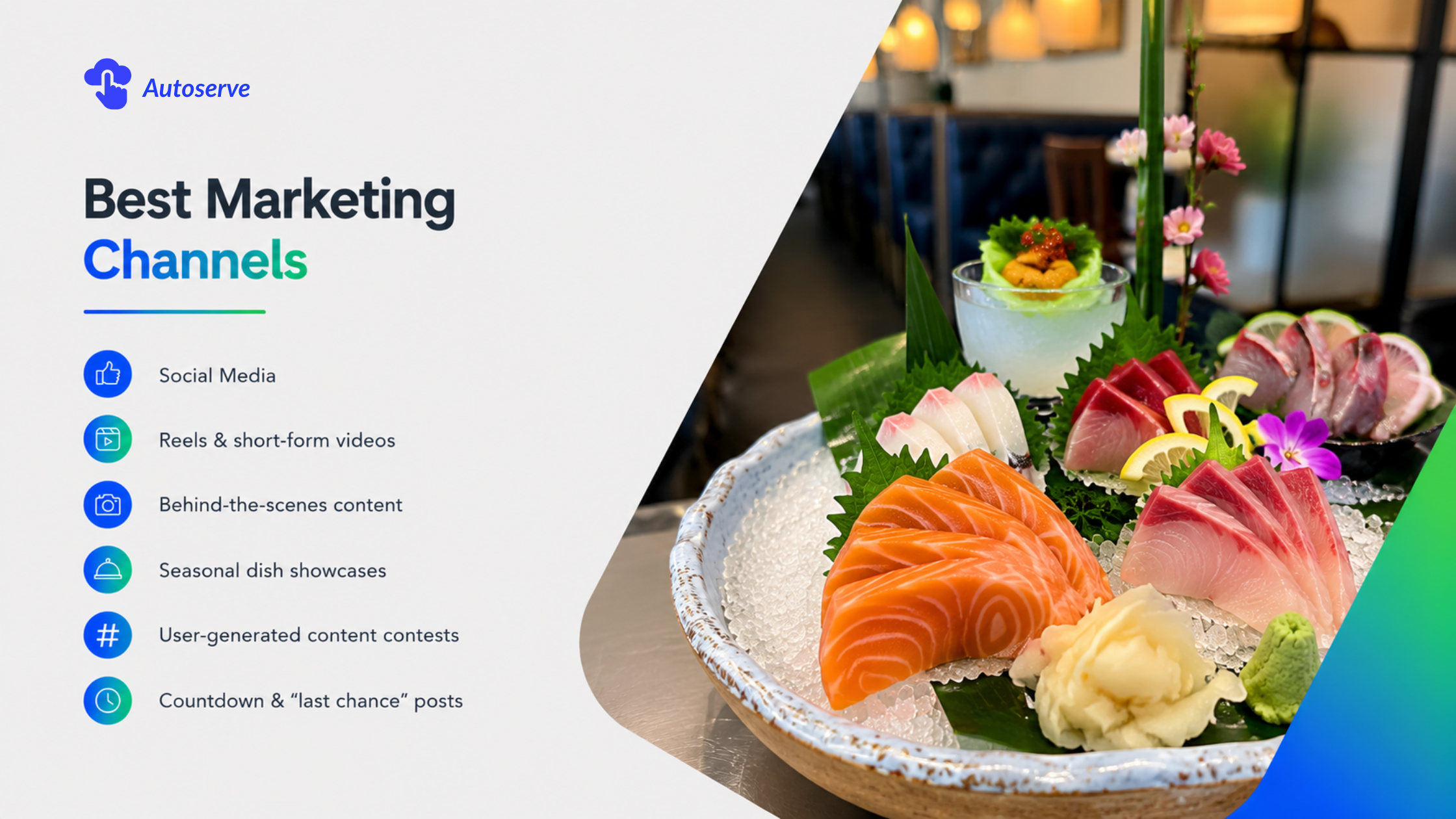
Campaign fatigue is real. By week three of a four-week promotion, engagement typicallydrops by 30–40% on organic social media. Here's how to fight the mid-seasonslump:
• Introduce a mid-season variation: a new topping option,a cocktail pairing, or a limited weekend brunch version of the seasonal dish.
• Run a user-generated content (UGC) contest: ask guests to post their seasonal dish with a branded hashtag for a chance to win a gift card.
• Add a countdown element: "Only 10 days left"posts consistently outperform standard promotional content in engagement rates.
• Feature a guest story: share a real guest photo andmini-story about their experience with the seasonal item.
These tactics don't require a big budget. They require planning ahead, which is exactly what your competitors aren't doing.
Not all social content performs equally for seasonal menu promotions. The format, timing, and call to action each play a major role in whether a post drives realtraffic or disappears into the feed.
Based on 2023–2024 industry benchmarks from Hootsuite and Later's Restaurant Social Media Report, here are the highest-performing formats for seasonal menu content:
The single highest-impact action you can take is optimizing for saves. Instagram's algorithm favors content that gets saved, it's the strongest signal that your content is valuable. Posts that generate saves get pushed to Explore and Suggested content, compounding your reach for free.
To maximize saves: include a genuine reason to save (a recipe tip, a pairing suggestion, a"come back before it's gone" reminder). Ask directly: "Save this post so you don't forget to try this before it's off the menu."
Posting timing matters more than most restaurants realize. According to Sprout Social's2024 data, the highest engagement windows for restaurant content are:
• Tuesday–Thursday: 11am–1pm and 7pm–9pm
• Friday–Saturday: 6pm–9pm
• Sunday: 10am–12pm (brunch content performs especially well)
Don't post and disappear. Reply to every comment in the first 30 minutes, this signals to the algorithm that the post is generating conversation, which boosts distribution.
Email and SMS are your two highest-ROI channels for seasonal restaurant promotions, because they reach people who already know and like your restaurant. You're not building awareness; you're converting warm intent into reservations.
Email marketing for restaurants generates an average return of $36 for every $1 spent(Litmus, 2023). SMS campaigns for restaurants see open rates of 90–98%, withmost messages read within three minutes of receipt (SimpleTexting, 2024).
Here is aproven seasonal campaign email sequence:
• Email 1 (3 weeks before launch): Teaser "Something new is coming. Here's a hint." Include one tantalizing image.
• Email 2 (launch day): Full reveal new seasonal menu, link to make a reservation, strong visual, limited-time framing.
• Email 3 (mid-season, week 2): Social proof "Here's what guests are saying about our fall menu" + UGC photos.
• Email 4 (final week): Urgency "Last 7 days" subject line. Countdown clock graphic if possible.
For SMS, keep messages under 160 characters. Lead with the most compelling information. "Fall menu is BACK 🍂 Reservation spots are filling up.
Build your list proactively during busy seasons. A simple tablet at the host stand with a sign-up form. "Join our VIP list for seasonal menu previews" can add 50–100 new contacts per week during peak periods.
When someone searches "fall menu restaurants near me" or "best seasonaldinner [your city]," you want to appear at the top. Local SEO for seasonal promotions is one of the most under used channels in restaurant marketing.
These three actions drive the most local search visibility for seasonal campaigns:
1. Update your Google Business Profile for every seasonal launch. Add your seasonal menu items as a Google Business "Menu" update. Post a Google Business photo of the seasonal dish with a keyword-rich caption. These posts appear directly in local search results and on Google Maps. Restaurants with active Google Business profiles get 5x more direction requests than those within active profiles (Google, 2023).
2. Create a seasonal landing page on your website. A simple page titled "Fall Menu2025 | [Restaurant Name] | [City]" with your seasonal dishes, photos, anda reservation button gives Google a specific page to rank for seasonal searches. This page can be refreshed each year with minimal effort.
3. Earn local press and backlinks. Reach out to local food bloggers, the city's lifestyle magazine, and your local newspaper food section not for national coverage, but for the local backlink and the community credibility. A mention in "10 Best Fall Menus in [City]" is worth more for local SEO than any amount of social posting.
Bonus tactic: use structured data (schema markup) on your seasonal landing page to mark up your menu items, operating hours, and events. This increases the chance of appearing in Google's AI Overview results for seasonal restaurant queries.
Use this checklist for every seasonal campaign, whether you're launching in 14 days or 12 weeks. Check each item off before your launch date:
If you can check every box, you're in better shape than 90% of restaurants running seasonal promotions. If you can't check more than half before launch, consider delaying by one week. A half-prepared campaign under performs a well-preparedone every time..
Once you've run two or three seasonal campaigns successfully, you have the raw material tobuild a full-year seasonal marketing system. This is where independent restaurants can create a real competitive advantage because most chains are too slow and too centralized to execute with local nuance.
Build a"Season Playbook" document for each of your four major campaign windows. Include:
• The winning menu items from previous years (ranked by sales and margin)
• The top-performing social posts (saved as templates to refresh)
• The email sequence copy (updated each year with fresh specifics)
• The supplier contacts and lead times for key seasonaling redients
• The campaign timeline checklist with pre-filled dates
After each season, hold a 60-minute debrief with your team. What worked? What didn't? What would you do differently? Document it. This institutional knowledge compounds over time and it becomes your unfair advantage over competitors who start from scratch every season.
A restaurant that runs four well-planned seasonal campaigns per year spring, summer, fall, and holiday creates twelve to sixteen branded touch points per year with every guest. That's twelve to sixteen moments to remind your community why they love your restaurant.
Most seasonal promotions perform best at 4–6 weeks. Shorter than four weeks limits your ability to build momentum; longer than eight weeks reduces the scarcity effectand guest urgency. For major holidays like Valentine's Day, a focused 7–10 day window works well.
Most successful independent restaurants update their menu seasonally roughly four times per year changing 20–30% of the menu each time. This keeps the experience fresh for regulars while preserving your best selling signature items.
No. A small, engaged local following outperforms a large disengaged one for restaurant promotions. The most effective approach is combining your existing email listand SMS database with local social content, not chasing follower counts.
Compare your revenue, cover count, and average check size during the campaign period to the same period the previous year. Also track campaign-specific metrics: email openand click rates, social post engagement and saves, and online reservation volumes with the seasonal keyword in the booking notes.
Yes, and independent restaurants havereal advantages: local relevance, authentic storytelling, and the ability toact quickly. The restaurants that do best in seasonal marketing are not the biggest. They're the most consistent andmost specific in their messaging.
Every season, your guests are already looking for reasons to go out to eat. They want to experience new flavors, celebrate occasions, and share meals that feel relevant to the moment.
The restaurants that win with seasonal marketing are not the ones with the biggest budgets or the most followers. They're the ones who start planning eight weeks before everyone else, who turn their seasonal menu into a story instead of a sales pitch, and who treat every guest visit during a campaign as an opportunity to build a relationship that lasts past the last frost.
You now have everything you need: a planning framework, a marketing calendar, proven promotion tactics, and the tools to execute. The next season is coming faster than you think. The question is not whether you'll have a seasonal menu. It's whether you'll have a plan to promote it.
Start today. Pick your next seasonal window. Build your brief. And go fill those tables.
We try to make easy and simple for every professionals. Get 30 days free trial - No credit card required.

